
ANYONE CAN BIKE PRETTY.
It starts with knowing we stand out from the crowd and feeling really great about that!



Why Bigger Is Better: The Design Story Behind the Bike Pretty Straw Hat Helmet Covers
Quick answerBike Pretty makes straw hat covers designed to fit over a bicycle helmet without compromising its safety. Every cover comes in three sizes for a snug crown fit, and the elastic cuff is designed to release in a crash so the helmet underneath can still do its job. The wide, gently sloped brim is inspired by early 1900s cycling fashion, when large hats were the norm for women riding bicycles.
Here's a problem you don't think about until you're the designing around it: bicycle helmets are bulky. Big, round, sporty, and built for going fast, or at least for looking like you could.
Vintage-inspired style is almost never about looking fast. It's charming, dramatic, impractical, and styled for looking wonderful while doing nothing athletic.

So what happens when you try to put a cute hat on top of a helmet? Usually, disappointment.
A flat cap looks great on a human head. Scale it up to fit over a bicycle helmet, and something goes wrong with the proportions. Same with a baseball cap, a beret, or a newsboy. A small hat looks chic. That neat, close silhouette beautifully frames the face. But scale it up to fit the size and shape of a bicycle helmet, and the whole thing changes for the worse. See, a typical bicycle helmet adds about ¾ of an inch of bulk around the head. It's important bulk. I love what it does to protect our skulls, but it does not give that carefree, vintage look.

A flat cap over a bicycle helmet just isn't the same silhouette as a flat cap on a human head. I tried my best to make it work anyway, but as a designer, I knew there had to be a better way.
I tried a lot of hat styles before I figured out how. The answer was hiding in a (digital) stack of 100-year-old bicycle posters.
What the Victorians Already Knew
When I started looking for early 1900s illustrations of women on bicycles I immediately notice something fast: enormous hats. Wide brims, dramatic embellishments, all worn without a shred of self-consciousness. The bigger the hat, the more fabulous the wearer looked.

A wide-brimmed straw hat is one of the only silhouettes that actually looks right when it's built big enough to cover a helmet underneath. The crown adds height. The width gives it presence instead of looking accidental. With a little clever fabric manipulation, the slope of the brim can be adjusted to hide the discordant ledge where the bicycle helmet ends. Where a small, structured hat looks overinflated and wrong at helmet scale, a wide, gently sloped brim looks like it was always meant to be that size.

Building a Hat That's Secretly a Safety Device
A helmet cover isn't just a hat in the largest possible size. It has a job to do, and the job comes with contradictions that don't resolve easily.
The cover has to fit snugly enough to stay on my helmet up to 30 miles an hour. But it also has to slip off easily if ever in a collision. I need the helmet's smooth outer shell doing its job without a layer of fabric getting in the way.
It has to look like it belongs on my head, not like a novelty hat worn by drunken fans at some kind of sporting event. But it also has to physically accommodate a hard plastic shell that's considerably wider than any human skull.
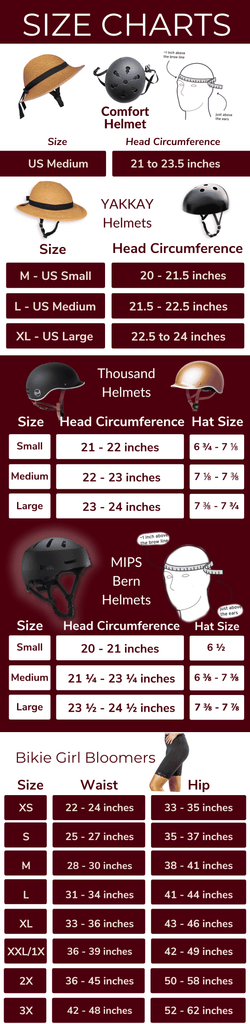
I've got a pile of test helmets in my office, literally dozens of them, accumulated over years, used for nothing but fit-testing cover after cover. Because of all that testing, every cover I make now comes in three sizes, since “one size fits most helmets” turned out to be a polite fiction! The crown of the cover, the part that sits over the very top of the helmet, needs a genuinely smooth, tailored fit for the whole thing to sit and look right, and no single size could deliver that across the range of helmets people actually ride in. (If you're not sure which size that means for you, I break it down here: How to Pick the Right Bike Helmet Size.)

The Helmet Underneath Matters Too
Not every helmet is an equally good partner for a hat. My favorite to work with is the Comfort Helmet, a US CPSC-standard helmet purpose-built to accept hat-style covers. Its flat rim gives the elastic cuff something to properly grip, instead of fighting a curved edge. (Not sure if your current helmet will work instead? I cover that here: Will the Straw Hat Cover Fit My Helmet?)

It also has more ventilation than most “hat-ready” helmets, which solved one of the most common complaints I used to hear. The old “hat ready” helmets prioritized a smooth crown over ample vent holes, and I get why: a row of vent holes gives a sport cycling helmet an unmistakable alien-creature look. When I lived in Italy, I nearly got laughed off the bike path by drivers pointing at my helmet and calling out “ET! ET!”
But holes need to be balanced against protection: more vents generally means a bulkier helmet is needed to keep the same level of safety. So it's a real trade-off, lots of vents and a bulkier silhouette, or a sleeker silhouette and fewer vents. With its 11 well-placed vent holes, the Comfort Helmet is the compromise I've landed on.

Small helmet detail, big difference in how the whole cover actually performs.
Ten Years, Still Iterating
I've been working with hat-making factories for a decade now, refining the same short list of questions on every cover I develop. (People sometimes ask if this is something you could just make yourself. I tried it and here's what I learned: Can I Make My Own Straw Hat Helmet?)
Does it fit over a helmet properly? Will it stay on at speed? Will it release safely if it needs to? Does the brim sit at the right angle, wide enough to make a statement, not so wide it becomes impractical? Does it, in the end, actually look like something I want to wear when I ride my bike in a sundress?
Every cover I make is still measured against that list. The idea came from a hundred-year-old illustration. Making it real has been a decade of testing, refitting, and a lot of helmets stacked in the corner of my office.

But it's all worth it when I hear from people like Susan:
My husband spent our entire marriage trying to get me to wear a bicycle helmet. Even after I got a concussion in a bike accident with my daughter, I still refused to wear one. I hated how hot my head got, and the sun glaring in my eyes. Then I saw Bike Pretty and thought, “I could wear that!” The hat covering stops the glare of the sun and keeps my head from baking. It's also quite lovely to wear! I did my first 20 mile bike ride yesterday and was complimented the whole way. I love how light the helmet and hat feel on my head. Debris was falling from the trees along the trail, and the hat kept all of it out of my face. It kept the sun off too, so I didn't have to squint. The best part is the elastic straps that hold the hat to the helmet. Even in strong wind, the brim stayed in place and the hat didn't budge. I'm in love with my Bike Pretty helmet hat, and I look forward to wearing it again and again. Best safety product out there, anywhere!
If you want to see where ten years of testing landed, take a look at the Straw Hat Helmet Cover.
Related Posts You Should Read
- What does the Straw Hat Bike Helmet look like on real people? Take a look at all the cute customers in their Straw Hat Bike Helmets.
- How to Bike in a Long Dress It's easy once you learn the trick!
- How to start biking even if you don't feel athletic Tips for building confidence and finding the right bike, whatever your fitness level.
- How to: Bike Bell Flower DIY A sweet, simple way to add a little extra charm to your ride.